बीजों का सही भंडारण और अंकुरण: विज्ञान, 4 अंकुरण विधियाँ और बीज गुणवत्ता की पहचान
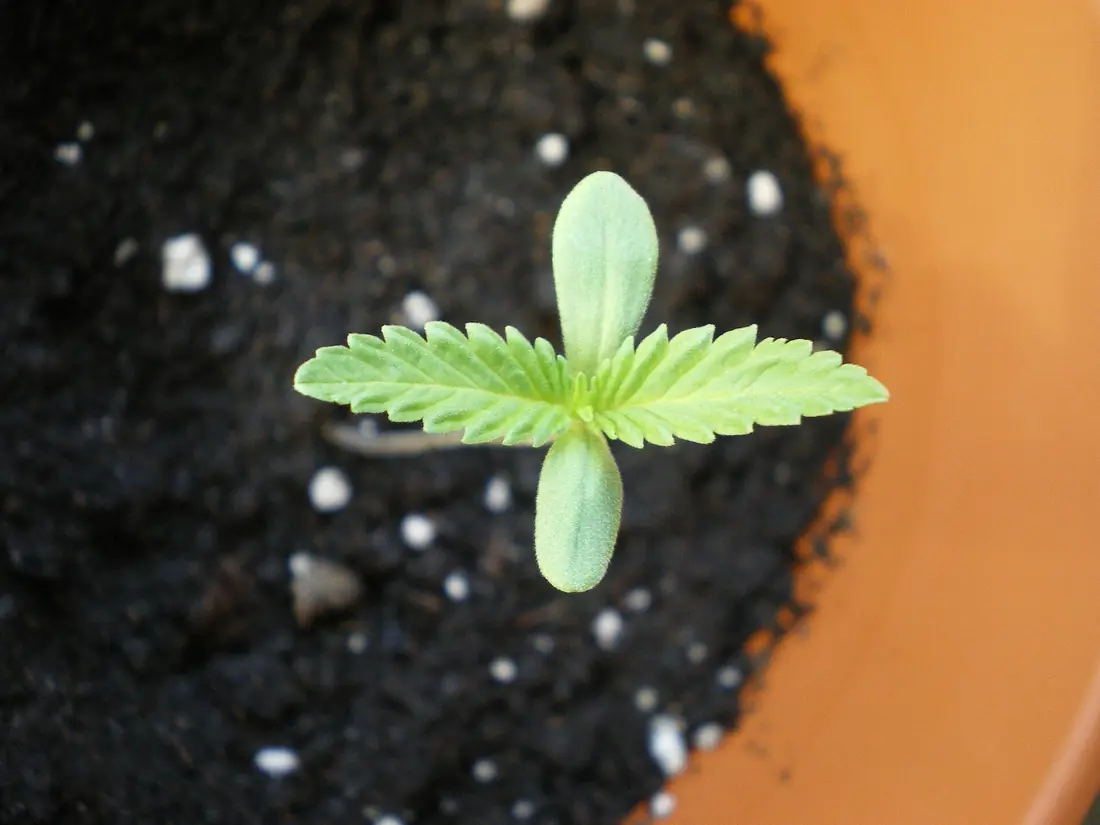

ऑर्थोडॉक्स बीज, हैरिंगटन के नियम, फ्रिज में भंडारण, 4 अंकुरण विधियों की तुलना, पौध के पहले 14 दिन और पुराने या व्हाइट-लेबल बीजों की पहचान।
1. Seed Biology & Aging: Orthodox Seeds, Harrington’s Rules & the 4 Enemies
Botanically, a cannabis seed is a single-seeded achene enclosing a living embryo and storage tissue rich in polyunsaturated fatty acids (30–35%) and edestin proteins (20–25%).[1][2] Cannabis seeds are orthodox seeds (Small & Brookes 2012): drying them to 5–8% moisture content puts the embryo into metabolic quiescence.[2] According to Harrington’s Rules (1972), every 1% reduction in seed moisture and every 5 °C reduction in storage temperature each independently doubles seed longevity.[1] The four enemies of seed viability are moisture (> 40% RH), heat (> 20 °C), temperature fluctuations, and light/oxygen (which drive lipid peroxidation of storage oils).[1][2]
2. Practical Storage Guide: From Dark Cupboard to Fridge (4–6 °C) & Freezer (-20 °C)
| Time Horizon | Storage Location & Temperature | Container & Humidity Control | Expected Viability |
|---|---|---|---|
| Short-term (6–12 months) | Cool, dark indoor cupboard (14–18 °C) | Airtight dark container with silica gel packet (20–30% RH). | 1–2 years good germination.[2] |
| Medium- to long-term (1–10 years) – Recommended! | Refrigerator (back shelf / crisper, never in the door!) at 4–6 °C | Labeled micro-vials inside an airtight, lightproof glass jar with rubber gasket + colour-indicating silica gel (15–25% RH). | 5–10+ years high germination & seed vigor.[1][2] |
| Ultra-long-term / Gene bank (10–25+ years) | Freezer at -18 to -20 °C (pre-dried seeds at 5–7% moisture only) | Pre-equilibrated with silica gel for 1–2 weeks before freezing in vacuum/airtight glass. | 10–25+ years.[1][2] |
Golden Thawing Rule: Never open a cold seed jar immediately after taking it out of the fridge or freezer! Let the sealed jar warm to room temperature for 2–4 hours first so room moisture does not condense on the cold seeds.[1]
3. Germination & First 14 Days: Methods Compared, Rescuing Old Seeds & 4 Beginner Mistakes
Optimal cannabis germination requires four conditions: 22–25 °C warmth[3], moist but well-aerated medium (like a wrung-out sponge, never waterlogged), darkness for the emerging radicle, and a planting depth of 1.0–1.5 cm.
- Direct sowing in starter soil, Jiffy or Eazy Plug: Safest method for autoflowers and outdoor plants – zero transplant shock to the taproot.
- Brief water soak (max. 12–24 hours) + moist paper towel / cloth between two plates or in a closed box: Rehydrates the seed coat and provides visual confirmation of radicle emergence before planting. (Never soak longer than 24 h or the embryo drowns from oxygen starvation!)
- Rescuing old seeds (> 5–10 years): Gently scuff the seed seam in a tube of fine sandpaper for 20 seconds (scarification) so water can penetrate hardened shells.
- 4 classic seedling mistakes: (1) “Helmet head” (stuck seed shell – soften with warm water drops for an hour before gently sliding off, never pry dry!), (2) “Hot soil” (heavily fertilised soil burns seedling roots – always use light starter mix), (3) Stretching / etiolation (weak light – move light closer and bury the stem to grow adventitious roots), and (4) Damping-off (Pythium/Fusarium stem rot from cold, soggy soil).[5]
4. Adventitious Roots (Stem-Borne Roots): How Buried Stems Grow New Roots
When a young cannabis stem (hypocotyl or lower internodes) is buried in dark, moist, well-aerated soil, parenchyma cells near the vascular cambium respond to darkness and the plant hormone auxin (indole-3-acetic acid, IAA) by dedifferentiating into new root primordia – forming vigorous adventitious roots (stem-borne roots) right out of the stem![4] well established
- This natural mechanism rescues stretched seedlings when buried deeper, powers stem-cutting propagation[4], and forms the foundation of Flo’s “Half-Pot + Topping + Adventitious Root” method (creating a second tier of roots beneath the 8 main branches).
- Natural root biostimulants such as willow water (salicylic acid + natural indolebutyric acid, IBA) and aloe vera gently support adventitious root initiation.[4]
5. When It’s NOT the Grower’s Fault: Seed Vigor Loss & “White-Label” Bulk Seeds
Seed science distinguishes between simple germination (radicle tip emergence) and seed vigor (the metabolic energy required to establish a healthy seedling).[1][2] Poorly stored seeds with oxidised endosperm reserves often fail to crack at all, or crack by 1–2 mm and then die 2–4 days later once their depleted lipid reserves run out. In addition, many heavily marketed commercial brands sell unstabilised white-label bulk seeds repackaged under famous cultivar names, resulting in wildly inconsistent phenotypes.
Flo’s Practical Experience

1. My germination routine: For outdoor grows and autoflowers, I germinate directly in soil or Jiffy pellets so the taproot never experiences transplant shock. For indoor photoperiod plants, I briefly pre-soak the seeds in water and then place them in a moist cloth between two plates or inside a closed lidded box at 22–25 °C until the white root tip appears.
2. My real experience with 10 expensive brand-name seeds: I once bought an expensive 10-pack from a major commercial seed bank. Despite using the exact same setup that gives me ~100% germination with my own seeds, 7 out of 10 did not germinate at all, 2 of the 3 that sprouted died after 2–4 days from zero seed vigor, and the 1 surviving plant had a completely different growth structure and terpene profile than advertised! If that happens to you, don’t blame yourself – watch out for stale white-label bulk seeds and stick to honest breeders who truly select and stabilise their lines.
Note: personal experiences are subjective and are not a buying recommendation (§ 6 KCanG).
🌍 अनुवाद संबंधी सूचना: यह लेख मूल रूप से जर्मन में लिखा गया है और सावधानीपूर्वक अनूदित किया गया है। यदि आप मातृभाषी हैं और आपको कोई वाक्य या वानस्पतिक शब्द दिखता है जिसे और बेहतर बनाया जा सकता है, तो कृपया हमें kontakt@igrowpedia.de या X (@MisterSm3ilz420) पर लिखें — सहयोग करने वाले सभी साथियों का नाम उनकी इच्छा से हमारे भाषा-संरक्षक आभार में शामिल किया जाएगा!
स्रोत
सभी लिंक अंतिम बार 22.10.2026 को जाँचे गए।
- Parihar P, Singh S, Singh R, Singh VP, Prasad SM (2015): Changing scenario in seed biology: Physiological, biochemical and molecular aspects of seed aging. Acta Physiologiae Plantarum 37:1–15 / Harrington JF (1972): Seed Storage and Longevity. In: Kozlowski TT (Hrsg.), Seed Biology, Vol. III, S. 145–245. Academic Press. doi:10.1016/B978-0-12-424303-3.50009-9 समीक्षा
- Small E, Brookes B (2012): Temperature and Moisture Content for Storage Maintenance of Germination Capacity of Seeds of Industrial Hemp, Marijuana, and Ditchweed Forms of Cannabis sativa. Journal of Natural Fibers 9(4):240–255. doi:10.1080/15440478.2012.737179 प्रायोगिक अध्ययन
- Geneve RL, Janes E, Kester ST, Hildebrand DF, Davis D (2018): Temperature Limits for Seed Germination in Industrial Hemp (Cannabis sativa L.). Crops and Soils / Proceedings of the International Plant Propagators’ Society / HortScience. doi:10.17660/ActaHortic.2019.1249.26 प्रायोगिक अध्ययन
- Caplan D, Stemeroff J, Dixon M, Zheng Y (2018): Vegetative Propagation of Cannabis by Stem Cuttings: Effects of Leaf Number, Cutting Position, Rooting Hormone, and Leaf Tip Removal. HortScience 53(11):1672–1677. doi:10.21273/HORTSCI13203-18 प्रायोगिक अध्ययन
- Punja ZK, Collyer D, Scott C et al. (2019): Pathogens and Molds Affecting Production and Quality of Cannabis sativa L. Frontiers in Plant Science 10:1120. doi:10.3389/fpls.2019.01120 अध्ययन