ट्राइकोम्स (राल ग्रंथियाँ): ये कैसे बनती हैं, आनुवंशिकी क्या तय करती है और इन्हें वैज्ञानिक रूप से कैसे बढ़ाएँ
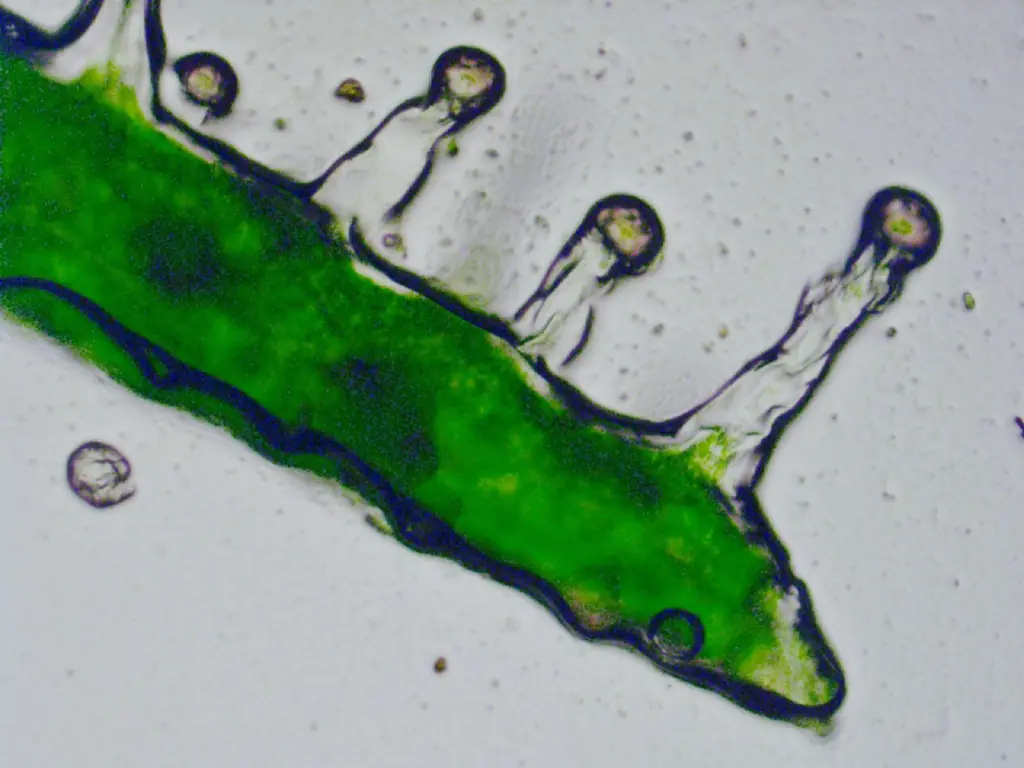

सूक्ष्मदर्शी के नीचे 3 प्रकार के ग्रंथिल ट्राइकोम, डिस्क कोशिकाओं में CBGA संश्लेषण, आनुवंशिकी बनाम पर्यावरण (PPFD, UV, नियंत्रित सूखा तनाव), मिथक जाँच और कटाई की परिपक्वता।
1. Anatomy & the 4 Trichome Types Under the Microscope (Why THCA Is Cytotoxic)
Cryo-EM and transcriptomic studies by Livingston et al. (2020, The Plant Journal) and Tanney et al. (2021) distinguish non-glandular protective hairs from three glandular trichome types on Cannabis sativa:[1][2] well established
- Non-glandular cystolithic and slender hairs: Pointed protective hairs without resin heads that deter insect herbivores and reduce boundary-layer water loss.[2]
- 1. Bulbous trichomes (10–20 µm): Tiny 2–4-cell glands on stems and leaves with minimal total resin volume.[1][2]
- 2. Capitate-sessile trichomes (25–50 µm): Stemless resin spheres sitting directly on the epidermis with a rosette of ~8 secretory disc cells; on floral bracts, many elongate into stalked trichomes during bloom.[1]
- 3. Capitate-stalked trichomes (150–500 µm tall – the main resin factories): Form the glittering frost on female bracts (calyxes) and sugar leaves, featuring a ring of 12–16+ plastid-rich secretory disc cells beneath a large balloon-like subcuticular storage cavity.[1][2]
Why does cannabis store THCA/CBDA outside its own cells? Inside the secretory disc cells, olivetolic acid and geranyl pyrophosphate (GPP) are fused into CBGA and exported into the extracellular subcuticular cavity together with monoterpenes and THCA/CBDA synthases.[1][3] As shown by Sirikantaramas et al. (2005), THCA and CBDA are directly cytotoxic to living plant cells (inducing apoptosis) – sequestering them inside an external cuticular sac dissolved in terpenes protects the plant while shielding flowers against UV radiation, desiccation and insects![3]
2. Genetics vs. Environment: Proven Levers to Boost Resin & Debunked Grow Myths
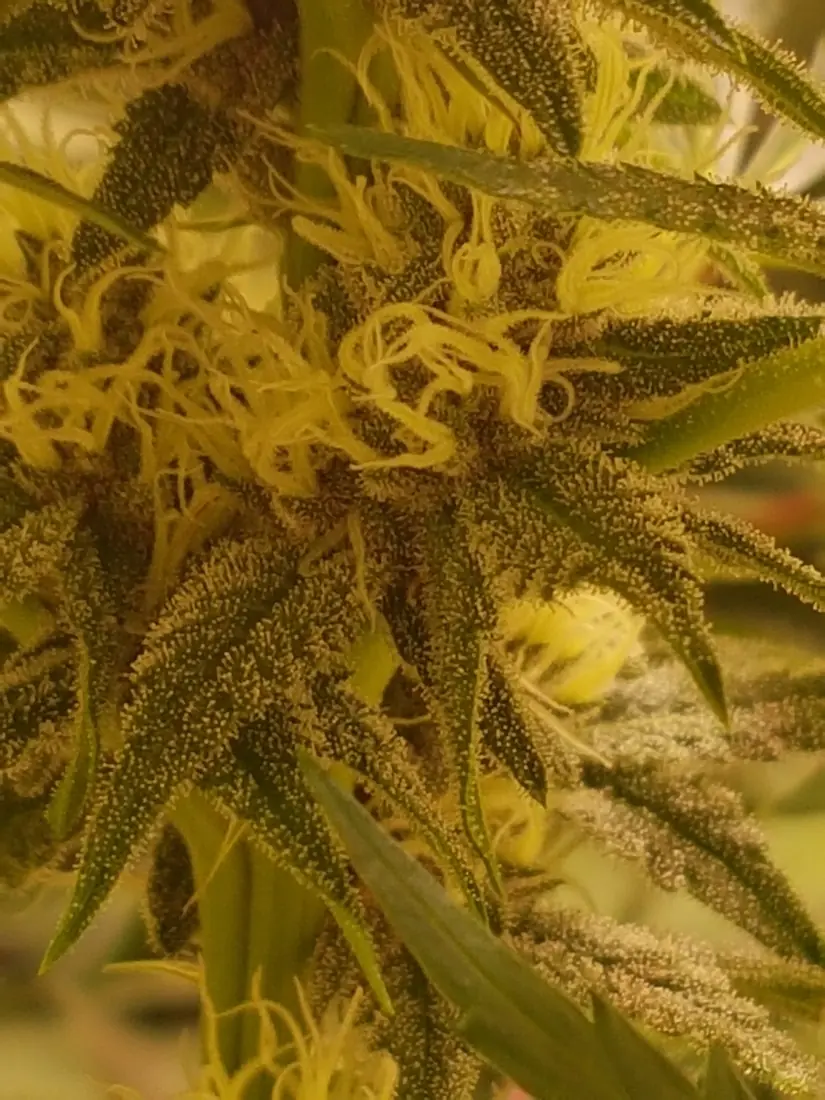
While genetics define ~70–80% of the cannabinoid and trichome ceiling, four peer-reviewed environmental levers help a plant reach 100% of its genetic potential:[4][5][6]
4 Scientifically Proven Levers for Resin & Terpenes
- 1. High PPFD & full-spectrum LED (blue / moderate UV-A & UV-B): Floral biomass and total cannabinoid yield per m² scale strongly with PPFD (Rodriguez-Morrison et al. 2021)[5], and blue-rich LED spectra enhance cannabinoid and terpene accumulation compared to HPS (Magagnini et al. 2018).[6]
- 2. Controlled drought stress in late flower (+12% THCA / +13% CBDA): In a controlled trial by Caplan, Dixon & Zheng (2019, HortScience), applying a single controlled drought cycle in week 7 of flowering increased THCA concentration by 12%, CBDA by 13%, and total THC/CBD yield per area by 43–67%![4]
- 3. Cool, dry late-flower climate (protecting volatile monoterpenes): Keeping canopy temperatures at 20–23 °C day / 16–18 °C night and 40–45% RH during the final two weeks prevents volatile monoterpenes (myrcene, limonene, pinene) from evaporating.
- 4. Living Soil & natural elicitors (chitin/chitosan, kelp, silica): Microbial rhizosphere signalling and chitosan gently stimulate jasmonic-acid defense pathways, while soluble silicon reinforces trichome stalks.
Debunked Grow Myths
- Myth “48–72 hours of total darkness before harvest boosts THC by 30%”: Plastid CBGA and terpene biosynthesis requires photosynthetic ATP/NADPH.[1][5] Multi-day darkness in a humid tent mainly raises the risk of Botrytis bud rot. (Simply harvest at the end of the normal night cycle right before lights-on!)
- Myth “flushing roots with ice water” or “splitting/nailing the main stem”: Causes root shock and vascular damage without increasing trichome density.
3. Reading Trichome Ripeness (Clear, Milky, Amber): The Microscope Harvest Guide
Always inspect trichome heads with a 60×–100× jeweller’s loupe directly on the floral bracts (calyxes) – never on the protruding sugar leaves, which turn amber 1–2 weeks earlier![1]
| Trichome Head Colour (60×) | Biochemical State in the Storage Cavity | Effect & Aroma Profile | Harvest Recommendation |
|---|---|---|---|
| Clear / Translucent | Resin gland still filling; high CBGA precursor, THCA/terpenes below peak.[1] | Immature, grassy aroma; short-lived or edgy effect. | Too early – wait 1–3 weeks. |
| Milky / Cloudy White | Peak THCA/CBDA and monoterpene concentration filling the cavity.[1][2] | Full cultivar terpene profile; clear, potent, uplifting/balanced effect. | Ideal harvest window opens (at 70–85% milky). |
| Amber / Golden-Brown | Oxidative degradation converts THCA → CBNA / CBN (cannabinol); volatile monoterpenes decline.[1][2] | Heavier, more sedative body effect (“couch-lock”). | 10–30% amber (+ 70–90% milky) = classic sweet spot. |
Flo’s Experience: “Understand nature, then copy nature”
Following my motto “Understand nature, then copy nature” (Kapier die Natur, dann kopier die Natur), I never torture plants with ice water or nails in the stem. In nature, trichomes are the female flower’s shield against mountain sun, dry late-summer wind and cool autumn nights. In the tent, I give my plants a massive double-tier root system (Half-Pot + Adventitious Roots), an even canopy under full-spectrum LEDs, let the pots dry back slightly more between waterings in late bloom, drop temperatures to 17–21 °C at 40–45% RH in the final two weeks, and harvest when calyx trichomes are ~80% milky and 15–20% amber!
Note: personal experiences are subjective and are not a recommendation.
🌍 अनुवाद संबंधी सूचना: यह लेख मूल रूप से जर्मन में लिखा गया है और सावधानीपूर्वक अनूदित किया गया है। यदि आप मातृभाषी हैं और आपको कोई वाक्य या वानस्पतिक शब्द दिखता है जिसे और बेहतर बनाया जा सकता है, तो कृपया हमें kontakt@igrowpedia.de या X (@MisterSm3ilz420) पर लिखें — सहयोग करने वाले सभी साथियों का नाम उनकी इच्छा से हमारे भाषा-संरक्षक आभार में शामिल किया जाएगा!
स्रोत
सभी लिंक अंतिम बार 22.10.2026 को जाँचे गए।
- Livingston SJ, Quilichini TD, Booth JK et al. (2020): Cannabis glandular trichomes alter morphology and metabolite content during flower maturation. The Plant Journal 101(1):37–56. doi:10.1111/tpj.14516 प्रायोगिक अध्ययन
- Tanney CAS, Backer R, Geitmann A, Smith DL (2021): Cannabis Glandular Trichomes: A Cellular Metabolite Factory. Frontiers in Plant Science 12:721986. doi:10.3389/fpls.2021.721986 समीक्षा
- Sirikantaramas S, Taura F, Tanaka Y, Ishikawa Y, Morimoto S, Shoyama Y (2005): Tetrahydrocannabinolic acid synthase, the enzyme controlling marijuana psychoactivity, is secreted into the storage cavity of the glandular trichomes. Plant and Cell Physiology 46(9):1578–1582. doi:10.1093/pcp/pci166 प्रायोगिक अध्ययन
- Caplan D, Dixon M, Zheng Y (2019): Increasing Inflorescence Dry Weight and Cannabinoid Content in Medical Cannabis Using Controlled Drought Stress. HortScience 54(5):964–969. doi:10.21273/HORTSCI13847-18 प्रायोगिक अध्ययन
- Rodriguez-Morrison V, Llewellyn D, Zheng Y (2021): Cannabis Yield, Potency, and Leaf Photosynthesis Respond Differently to Increasing Light Levels in an Indoor Environment. Frontiers in Plant Science 12:646020. doi:10.3389/fpls.2021.646020 प्रायोगिक अध्ययन
- Magagnini G, Grassi G, Kotiranta S (2018): The Effect of Light Spectrum on the Morphology and Cannabinoid Content of Cannabis sativa L. Medical Cannabis and Cannabinoids 1(1):19–27. doi:10.1159/000489030 प्रायोगिक अध्ययन