La pianta maschio, raccolta del polline, incrocio mirato ed ermafroditismo
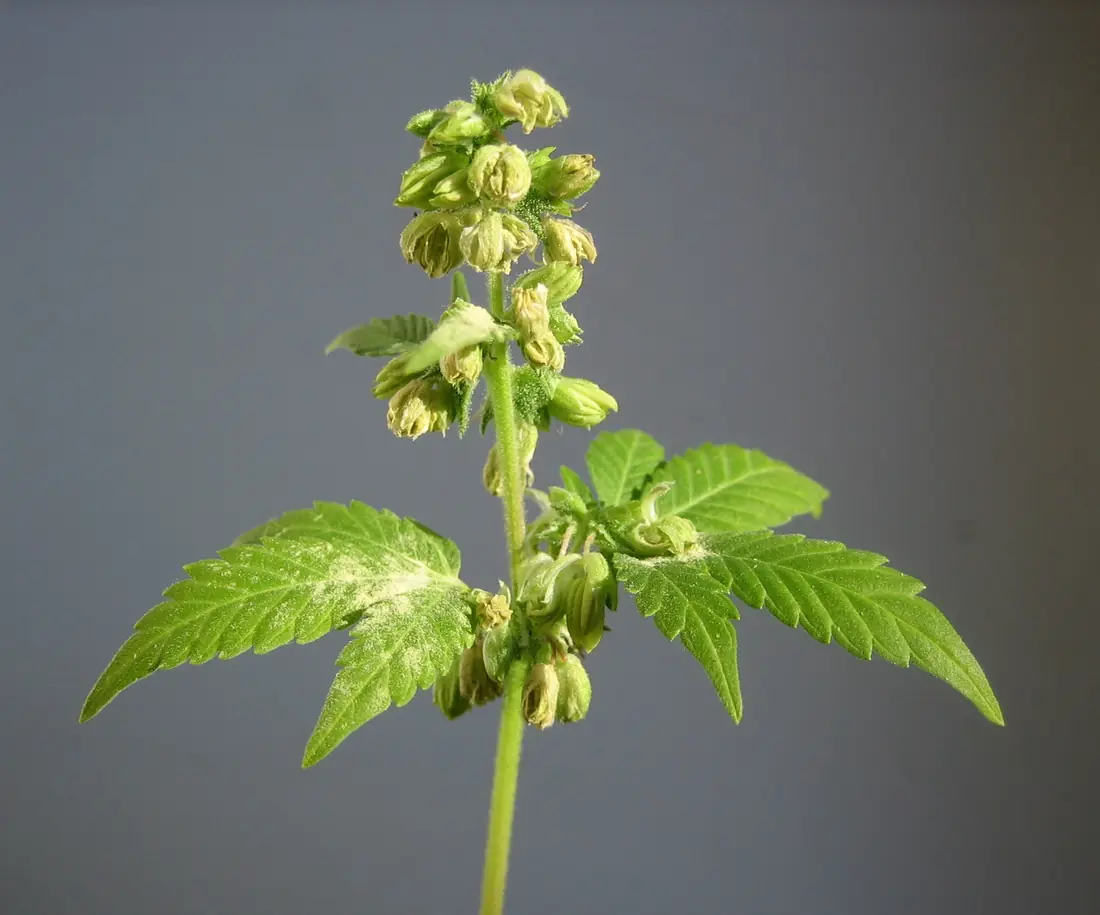

For growers focused solely on seedless flowers (sinsemilla), a male plant in the tent is usually an unwelcome surprise. Yet anyone who wants to understand cannabis biology, preserve prized genetics as seed, or breed vigorous new lines needs to master male plants and floral sex expression. This guide covers early preflower sexing, pollen harvesting and deep-freeze storage, controlled branch pollination, S1 feminisation with colloidal silver versus regular male–female breeding, and how to distinguish true genetic hermaphrodites from late-flower stress “bananas”.
🌱 Flo’s Guiding Motto for Breeding & Growing: “Understand nature, then copy nature!” (Kapier die Natur, dann kopier die Natur)
In the wild, cannabis thrives through genetic recombination between male and female plants – the foundation of adaptability, pest resistance and true hybrid vigour (heterosis).
1. Biology of Male Cannabis sativa (XY Sex Determination & Wind Pollination)
Cannabis sativa L. is naturally a dioecious, wind-pollinated (anemophilous) species: female plants carry XX chromosomes and male plants carry XY chromosomes.[1][2] Males typically stretch taller and open their staminate flowers 1 to 2 weeks earlier than females so that their 25–30 µm pollen grains drift downward across the female canopy in the wind.[2]
2. Early Sex Identification at Preflower: Male vs. Female
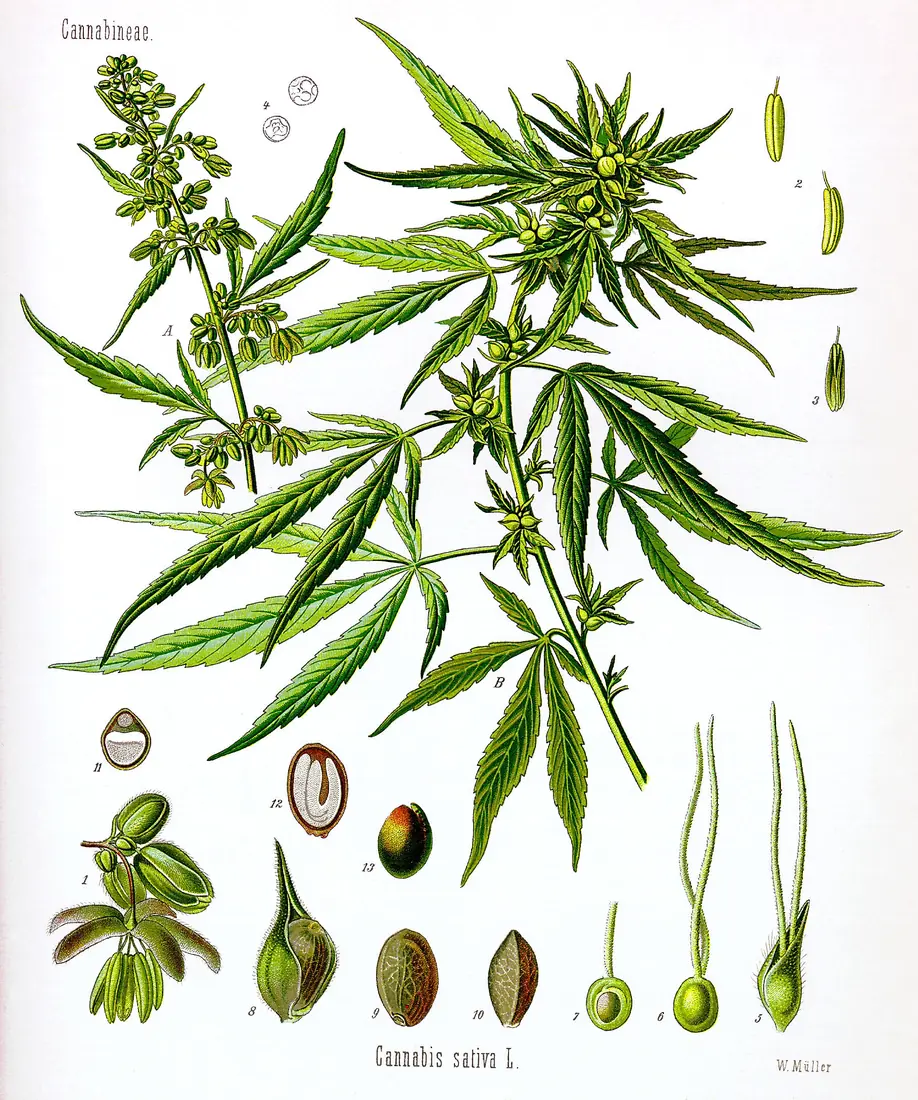

Preflowers appear at the stem nodes after 4–6 weeks of vegetative growth or 7–14 days after switching to a 12/12 photoperiod:[2][3]
- Male preflower: A smooth, spade-shaped sac on a tiny stalk (“ball on a stick”) with no white hairs, quickly developing into hanging clusters of pollen sacs.[2][3]
- Female preflower: A teardrop-shaped bract (calyx) sitting directly at the node with two white feathery stigmas (pistils) emerging from the tip.[2][3]
3. Facts vs. Myths: Do Male Plants Really Contain 0% Cannabinoids and Terpenes?
Myth: “Males contain zero cannabinoids and are useless.” Fact: Phytochemical studies (Small 2016; Welling et al. 2021) show that male floral sepals, anthers and upper leaves do bear glandular trichomes and produce cannabinoids and terpenes in the same chemotype ratio as their female siblings (though at lower total concentration than unpollinated female sinsemilla).[2][6] Breeders evaluate males via stem-rub terpene aroma, internode spacing, hollow stem structure and vigour.
4. How to Harvest, Dry & Store Pollen for Years (Plus the Water-Mist Trick)
- Isolate early and collect shedding pollen over parchment paper or glass away from airflow.
- Sieve & dry: Remove all green anther debris through a fine mesh (moisture causes mould!), let dry for 12–24 hours, and mix 1:4 to 1:10 with oven-dried cooled flour or cornstarch.
- Cold storage: Seal in airtight vials with silica gel packets in the refrigerator (4 °C, weeks/months) or freezer (-20 °C, 1–3+ years).[2]
- Water-mist trick: Plain water immediately ruptures/inactivates stray cannabis pollen via osmotic shock![2]
5. Controlled Single-Branch Pollination in Practice
Turn off fans, bag the rest of the female plant in week 3–4 of flower, gently brush pollen onto the white stigmas of a single labeled lower branch, wait 60–90 minutes, mist the branch with plain water to neutralise loose pollen, and harvest 20–80 tiger-striped seeds 4–6 weeks later while the rest of the plant remains seedless.[2][4]
6. Essential Breeding Terms Explained: P1, F1, F2, Backcross (BX), IBL & S1
P1 (parental lines) → F1 (uniform first filial generation with hybrid vigour / heterosis) → F2 (wide Mendelian segregation ideal for pheno-hunting) → IBL (inbred line stabilised over F4–F5+) → BX (backcross to lock in a parent trait) → S1 (first selfed generation of a female clone).[4][5][7]
7. Preserving Genetics via S1 (Colloidal Silver) vs. True Breeding (Male × Female)
S1 Feminisation with Colloidal Silver (Preserving a Prized Cut)
- Biochemical mechanism: Taking cuttings from a female plant (XX) and spraying one cutting at the onset of flowering with colloidal silver (CS, ≥ 30 ppm) (or silver thiosulfate, STS) delivers silver ions (Ag⁺) that block ethylene receptors.[4][5]
- Because ethylene promotes female flower formation, blocking it induces the genetically female cutting (XX) to form male pollen sacs whose pollen carries 100% X chromosomes.[4][5]
- Pollinating an unsprayed sister cutting yields feminised S1 seeds to back up a favourite cultivar in the fridge. Safety rule: Never consume any plant treated with silver![5]
Why True Breeding Requires Male (XY) + Female (XX)
- Repeatedly selfing clones with silver creates a severe genetic bottleneck and inbreeding depression.[5]
- Flo’s breeding philosophy (“Understand nature, then copy nature”): Creating genuinely new, vigorous and stable cultivars requires crossing regular male (XY) and female (XX) plants and selecting across multiple generations for structure, vigour and terpene profile.
8. Hermaphrodites: True Genetic Intersex Plants vs. Late-Flower Stress “Bananas”
As documented by Punja & Holmes (2020, Frontiers in Plant Science), growers must distinguish two forms of hermaphroditism:[3]
- 1. True genetic hermaphrodites: Form both stalked male pollen sacs and female calyxes at the nodes early in flowering (remove heavily affected plants early).[3]
- 2. Stress-induced late-flower anthers (“bananas” / nanners): Bare yellow stamens pushing directly out of female buds in late flower without a sac, triggered by light leaks during the dark period, severe heat/VPD stress, or over-ripening (rodelisation). Pluck isolated bananas with wet tweezers and fix environmental stress![3][5]
Flo’s Practical Experience
When I want to preserve a special keeper phenotype in seed form, I take cuttings, spray one cutting with colloidal silver at the start of bloom so Ag⁺ ions block ethylene and produce XX pollen, and pollinate a sister cutting for S1 backup seeds (always disposing of the sprayed plant afterwards). But when breeding a truly new cultivar, I always use regular male and female plants and select across generations for vigour, structure and terpene profile rather than endlessly silver-copying clones!
Note: personal experiences are subjective and are not a recommendation.
🌍 Nota sulla traduzione: Questo articolo è stato scritto originariamente in tedesco e tradotto con cura. Sei madrelingua e hai notato un’espressione o un termine botanico migliorabile? Scrivici a kontakt@igrowpedia.de o su X (@MisterSm3ilz420) – tutti i collaboratori vengono citati su richiesta nei nostri Ringraziamenti ai Padrini linguistici!
Fonti
Tutti i link verificati l’ultima volta il 22/10/2026.
- Prentout D, Razumova O, Rhoné B et al. (2020): An efficient RNA-seq-based segregation analysis identifies the sex chromosomes of Cannabis sativa. Genome Research 30(2):164–172. doi:10.1101/gr.251207.119 studio genetico
- Small E (2015): Evolution and Classification of Cannabis sativa (Marijuana, Hemp) in Relation to Human Utilization. The Botanical Review 81(3):189–294. doi:10.1007/s12229-015-9157-3 revisione
- Punja ZK, Holmes JE (2020): Hermaphroditism in Marijuana (Cannabis sativa L.) Inflorescences – Impact on Floral Morphology, Seed Formation, Progeny Sex Ratios, and Genetic Variation. Frontiers in Plant Science 11:718. doi:10.3389/fpls.2020.00718 studio sperimentale
- Kim J, Kim DG, Kim WJ et al. (2024): Characterization of Male Flower Induction by Silver Thiosulfate Foliar Spray in Female Cannabis at the Middle Reproductive Stage for Breeding. Plants 13(17):2429. doi:10.3390/plants13172429 studio sperimentale
- Timoteo Junior AA, Oswald IWH (2024): Optimized guidelines for feminized seed production in high-THC Cannabis cultivars. Frontiers in Plant Science 15:1384286. doi:10.3389/fpls.2024.1384286 revisione
- Welling MT, Liu L, Hazekamp A, Dowell A, King GJ (2021): Untargeted Metabolomic Analyses Reveal Chemical Complexity of Dioecious Cannabis Flowers. Australian Journal of Chemistry 74(6):463–479. doi:10.1071/CH21033 studio sperimentale
- de Meijer EPM, Bagatta M, Carboni A et al. (2003): The inheritance of chemical phenotype in Cannabis sativa L. Genetics 163(1):335–346. doi:10.1093/genetics/163.1.335 studio di incrocio