花穂の色づき:なぜ大麻植物は紫、赤、青、または黒色になるのか?
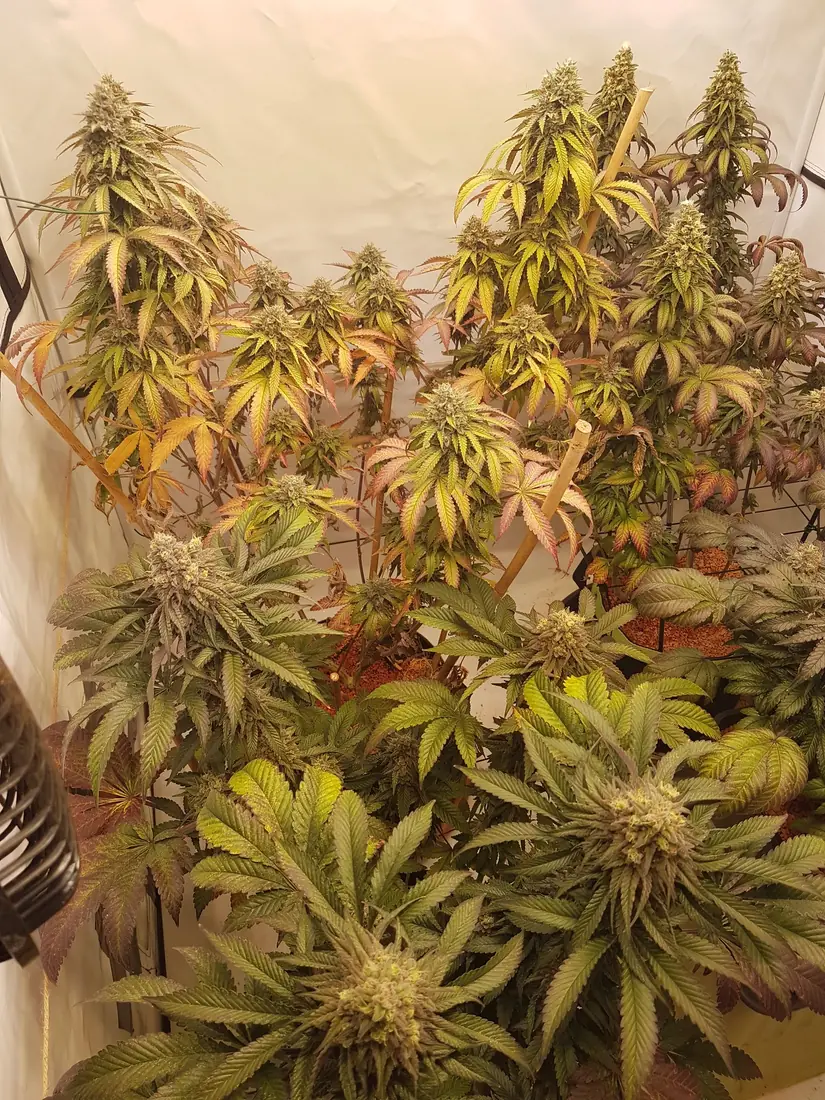
Deep purple calyxes, ruby-red fan leaves, bluish-lavender colas or almost jet-black foliage shortly before harvest: late-flower colour transformations are among the most striking sights in cannabis cultivation. Why do some cultivars turn purple effortlessly while others stay bright green even in the cold – and how do you tell healthy autumn pigmentation apart from phosphorus deficiency? Here is the plant biology behind floral colouration.
1. What Are Anthocyanins? Keracyanin & Cell Vacuole Storage
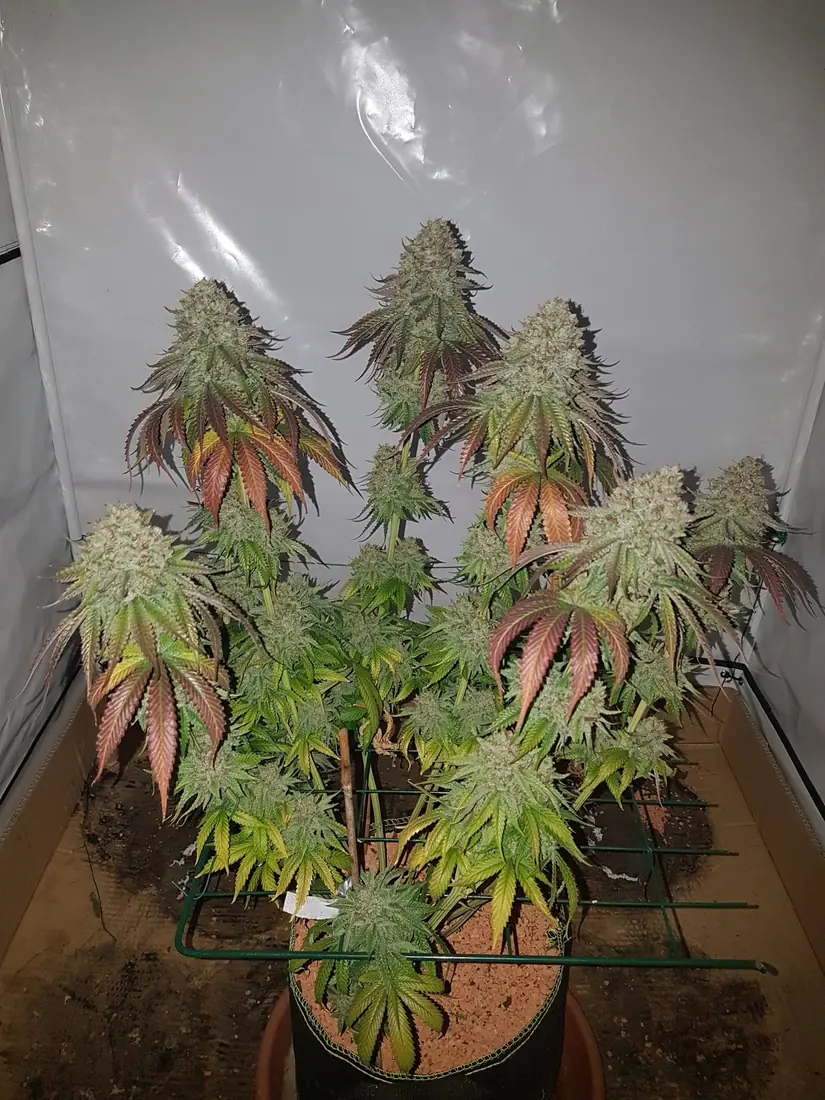
Unlike green chlorophyll (which is lipid-soluble and housed in chloroplasts), red, purple and blue plant pigments are anthocyanins – water-soluble flavonoid polyphenols stored inside the aqueous cell vacuole.[1][2] well established
In a landmark targeted HPLC-MS/MS and RT-qPCR study on purple Cannabis sativa tissues, Bassolino et al. (2023, Antioxidants) identified the exact molecular players:[1]
- Keracyanin (cyanidin-3-O-rutinoside) as the major pigment: Bassolino et al. demonstrated that cyanidin-3-rutinoside (keracyanin) is the predominant anthocyanin in purple cannabis leaves, stems and floral bracts, alongside smaller amounts of cyanidin-3-glucoside and peonidin derivatives.[1]
- Vacuolar import via CsDTX35: Once synthesised in the cytosol, glycosylated anthocyanins are imported into the central vacuole by a putative MATE-type transporter (CsDTX35).[1]
- Evolutionary role in nature: In high-altitude landraces (such as those from the Hindu Kush, Chitral and Kashmir), anthocyanins act as a photoprotective UV screen and potent antioxidant buffer against cold and radiation stress.[1][2][3]
2. Genetics vs. Temperature: Why Cold Alone Won’t Make Green Genetics Purple
- Genetics is the master switch: The anthocyanin biosynthetic pathway is regulated by the MYB–bHLH–WD40 (MBW) transcription factor complex (including CsMYB and CsTTG1).[1][2] Without active alleles of these regulatory genes, cold temperatures only cause stress and slow growth rather than purple buds.
- How cool nights amplify colour in late flower: When the genetic disposition exists, two processes work together during the final 2–3 weeks of flowering: (1) natural senescence breaks down green chlorophyll, unmasking underlying carotenoids and anthocyanins; and (2) cooler night temperatures (15–18 °C / 59–64 °F) stimulate anthocyanin gene expression while slowing chlorophyll synthesis.[1][2][3] Avoid freezing shocks below 12 °C, which stall root metabolism and trichome maturation![4]
3. Red, Purple, Blue or Black: How Vacuolar pH & Pigment Density Shape the Spectrum
| Visible Colour | Dominant Pigment | Cellular Mechanism (Vacuolar pH & Co-Pigmentation) |
|---|---|---|
| Ruby Red to Pink / Magenta | Pelargonidin, Peonidin & Cyanidin | More acidic vacuolar pH (~4.0–5.0) shifts anthocyanin absorption toward red/pink hues.[1][2] |
| Classic Purple / Violet | Keracyanin (cyanidin-3-rutinoside) | Slightly acidic to neutral vacuolar pH (~5.5–6.5) in calyxes and sugar leaves.[1] |
| Blue to Lavender | Delphinidin derivatives + flavone co-pigments | Neutral to slightly alkaline vacuolar pH (> 6.5) and metal-ion complexation (e.g. Blueberry lines).[2] |
| Deep Purple-Black | High keracyanin density + underlying chlorophyll | Extreme anthocyanin concentration overlying dark-green palisade chlorophyll absorbs nearly all visible light, appearing almost jet black.[1][2] |
| Golden Yellow to Autumn Orange | Carotenoids (lutein, β-carotene) | Chlorophyll breakdown in late bloom unmasks yellow/orange carotenoids in low-anthocyanin cultivars.[2] |
4. Healthy Autumn Colouration vs. Phosphorus (P) Deficiency (Comparison Table)
| Feature | Healthy Genetic / Autumn Anthocyanins | Phosphorus (P) Deficiency / Root Cold Lock |
|---|---|---|
| Timing & Location | Late flowering (or uniformly on calyxes from early bloom in true purple lines); starts on light-exposed upper leaves and bracts. | Any stage; starts on older lower/middle leaves and red-purple petioles.[4] |
| Leaf Health & Vigor | Leaves remain turgid and symmetrical; buds swell normally. | Dull dark-green leaves with bronze/purple necrotic blotches, curled dry tips and stunted bud growth.[4] |
5. Grow Myths Fact-Checked: Ice Water, Dyes & “Is Purple Weed Stronger?”
Does purple colour increase THC potency? No. Cannabinoids are synthesised inside glandular trichomes, whereas anthocyanins accumulate inside epidermal cell vacuoles.[1][5] Likewise, pouring ice water on roots does not cool the upper canopy – it only shocks root hairs and triggers nutrient lockout.
Flo’s Practical Experience
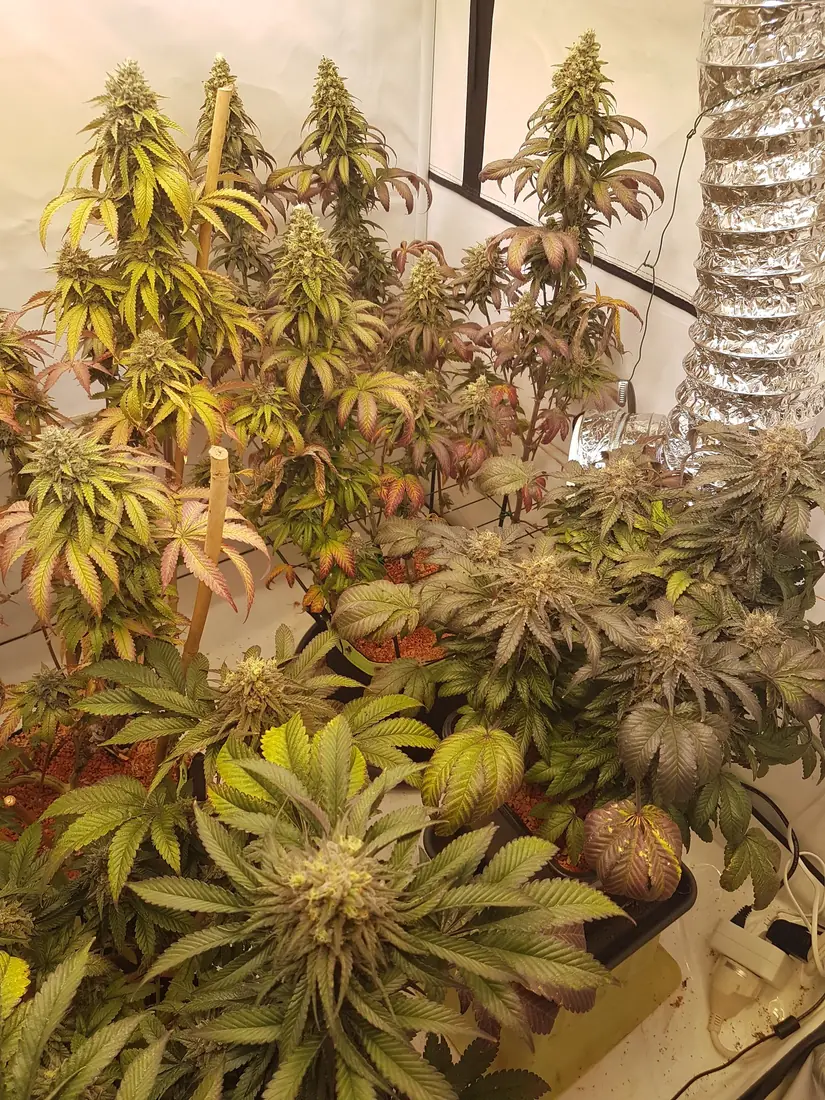
In my grow gallery (e.g. Mango Kush, Lemon Cherry Gelato, Blueberry, Eleven Roses and Black Apple Hitchcock), you can see how genetics and natural late-flower senescence turn the canopy into a sea of gold, ruby red and deep purple. Never torture a green cultivar with freezing temperatures – a gentle night drop to 16–18 °C in the final two weeks is plenty to bring out natural anthocyanins while preserving volatile terpenes!
Note: personal experiences are subjective and are not a recommendation.
🌍 翻訳に関するご案内:この記事はドイツ語の原文から丁寧に翻訳されています。母語話者の方で、より自然な表現や植物学の専門用語の改善点にお気づきの場合は、ぜひ kontakt@igrowpedia.de または X(@MisterSm3ilz420)までお知らせください。ご協力いただいた皆様は、ご希望に応じて言語サポーター謝辞にお名前を掲載いたします!
出典
すべてのリンクは2026年10月22日に最終確認しました。
- Bassolino L, Fulvio F, Pastore C, Pasini F, Gallina Toschi T, Filippetti I, Paris R (2023): When Cannabis sativa L. Turns Purple: Biosynthesis and Accumulation of Anthocyanins. Antioxidants 12(7):1393. doi:10.3390/antiox12071393 実験研究
- Tanaka Y, Sasaki N, Ohmiya A (2008): Biosynthesis of plant pigments: anthocyanins, betalains and carotenoids. The Plant Journal 54(4):733–749. doi:10.1111/j.1365-313X.2008.03447.x レビュー
- Landi M, Tattini M, Gould KS (2015): Multiple functional roles of anthocyanins in plant-environment interactions. Environmental and Experimental Botany 119:4–17. doi:10.1016/j.envexpbot.2015.05.012 レビュー
- Cockson P, Landis H, Smith T, Hicks K, Whipker BE (2019): Characterization of Nutrient Disorders of Cannabis sativa. Applied Sciences 9(20):4432. doi:10.3390/app9204432 実験研究
- André CM, Hausman JF, Guerriero G (2016): Cannabis sativa: The Plant of the Thousand and One Molecules. Frontiers in Plant Science 7:19. doi:10.3389/fpls.2016.00019 レビュー